
When Bà Ngoại Doesn't Understand: Honoring Elders When You Can't Find the Words
For many of us growing up in two cultures, the language barrier is the hardest part. We love our parents and grandparents deeply, but sometimes it feels like there is a glass wall between us. Here's how to honor your elders when words fail you.
It's a scene that happens in households across Hawaii every day.
You come home from a long day at school or work. Your brain is frying from a chemistry test, or maybe you had some serious drama with your friends. You walk into the kitchen, and there sits Bà Ngoại (or Grandma, Lola, Obachan, or Tutu).
She looks up, smiles, and asks in Vietnamese: "Hôm nay con đi học thế nào?" (How was school today?)
You want to tell her everything. You want to explain that you felt anxious about your presentation, or that your friend group is fighting, or that you're just really tired.
But your Vietnamese vocabulary stuck at a 3rd-grade level. You freeze. You search for the words, but they aren't there.
So, you just smile and say the only thing you know how to say: "Dạ, tốt." (Yes, good.)
And you walk to your room, feeling a little sad.
The "Silent" Gap
For many of us growing up in two cultures, the language barrier is the hardest part.
We love our parents and grandparents deeply. We respect them. But sometimes, it feels like there is a glass wall between us. They don't fully understand our American/Local life because we can't explain it to them, and we don't fully understand their stories because we miss the details in translation.
It can make you feel guilty. You might think: Am I a bad grandson/granddaughter because I can't hold a deep conversation with her? Am I failing the Fourth Commandment (Honor your Father and Mother) because I can't share my life with them?
Love Without Subtitles
Here is the good news: Love does not require perfect grammar.
As Catholics, we know that communication is more than just words. The Fourth Commandment isn't "Honor your father and mother only if you can explain your emotions perfectly in their native tongue." It is about Honor, and that is an action, not a vocabulary test.
If you are struggling to connect with Bà Ngoại or your parents because of the language gap, here are three ways to bridge it without a dictionary.
1. The Ministry of Presence (Just Be There)
Sometimes, we think we need to talk to bond. But in many Asian and Pacific Islander cultures, just being together is enough.
Sit with her while she watches her Korean dramas (dubbed in Vietnamese, of course) or Paris By Night. Sit at the table while she cooks. You don't have to say anything profound. Just your physical presence says, "You are important to me. I choose to be here with you instead of on my phone."
2. The Universal Language of "Cut Fruit"
You know the meme: Asian parents/grandparents don't say "I love you," they bring you a plate of cut fruit.
You can speak that language back!
- Cut mango or papaya for them.
- Offer to drive them to Mass or the market.
- Fix the Wi-Fi or their iPad when it breaks (without complaining!).
These small acts of service translate perfectly. They say "I love you" louder than any sentence you could stumble through.
3. Pray in the "Middle"
This is the most powerful tool we have as Catholics.
When you can't explain your worries to your parents, bring them to God together.
Try praying the Rosary with them. Even if you stumble on the Vietnamese words, the rhythm is the same.
Go to Mass together. You sit there, shoulder to shoulder, looking at the same Jesus.
In the Eucharist, there is no language barrier. When you pray for your Bà Ngoại, and she prays for you, your souls are communicating perfectly through the Holy Spirit.
You Are Not Strangers
Don't let the lack of words make you feel distant. Your grandparents look at you and they don't see a "language failure." They see their legacy. They see the future they prayed for.
So next time you reply with a simple "Dạ, tốt," don't feel bad. Just follow it up with a hug, or sit down and eat the phở she made. She understands more than you think.
You are a Saint in Training. And love, even silent love, is still love.
Related Articles
Holy Week Survival Guide: What Happens Each Day and Why It Matters
Holy Week is not just "the week before Easter." It is the most intense, dramatic, and important week in all of human history, and the Church lets us walk through every single day of it.
Lent: It Is Not Just About Giving Up Boba (The Spiritual Bootcamp)
Lent is way more than just a diet or a test of willpower. It is a spiritual bootcamp designed to get us ready for the biggest event in history: Easter.
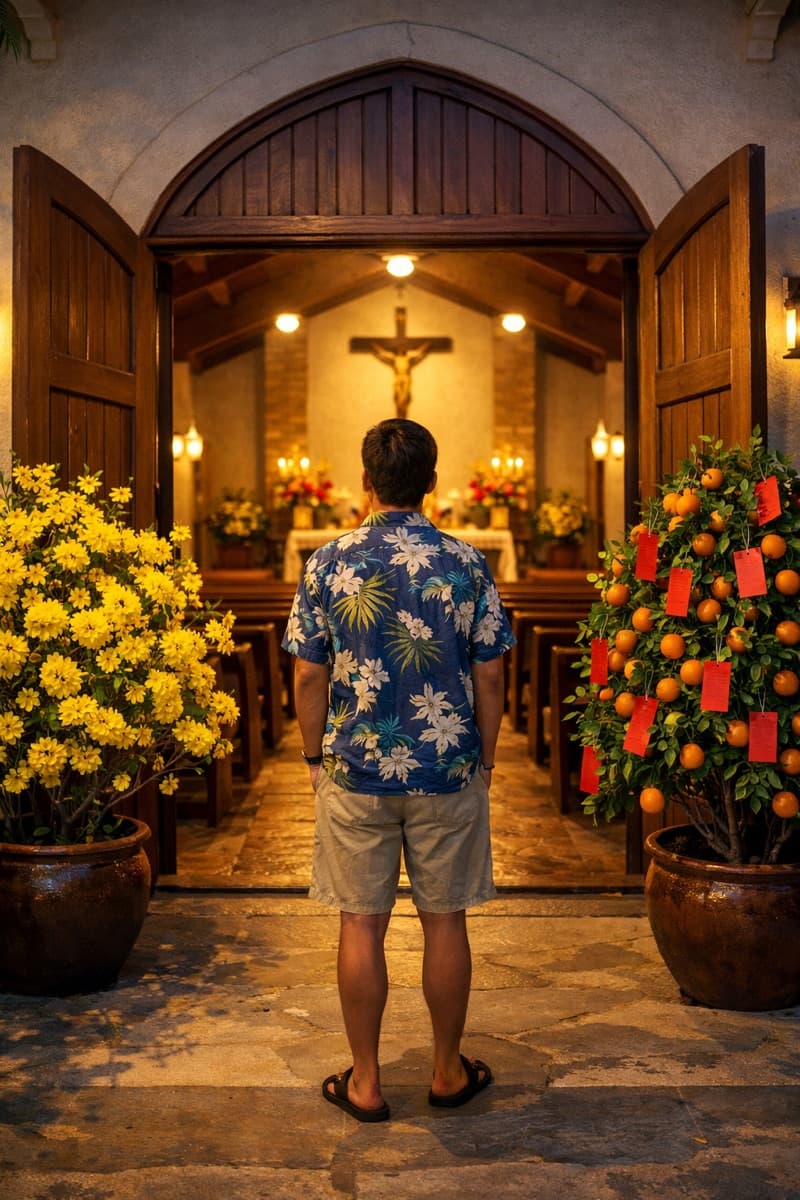
Coming Home for Tết: A Guide to Returning to Church (Nobody is Checking Attendance)
Tết is the season of "Returning." We return to our parents' home to pay respects. But for some of you, there is one "House" you have been avoiding. Here is your guide to walking back through those doors without freaking out.
Enjoyed This Article?
Explore more reflections and insights from our community.